Why the NHS Struggles to Go Paper-Free: What Patients Should Know
PART C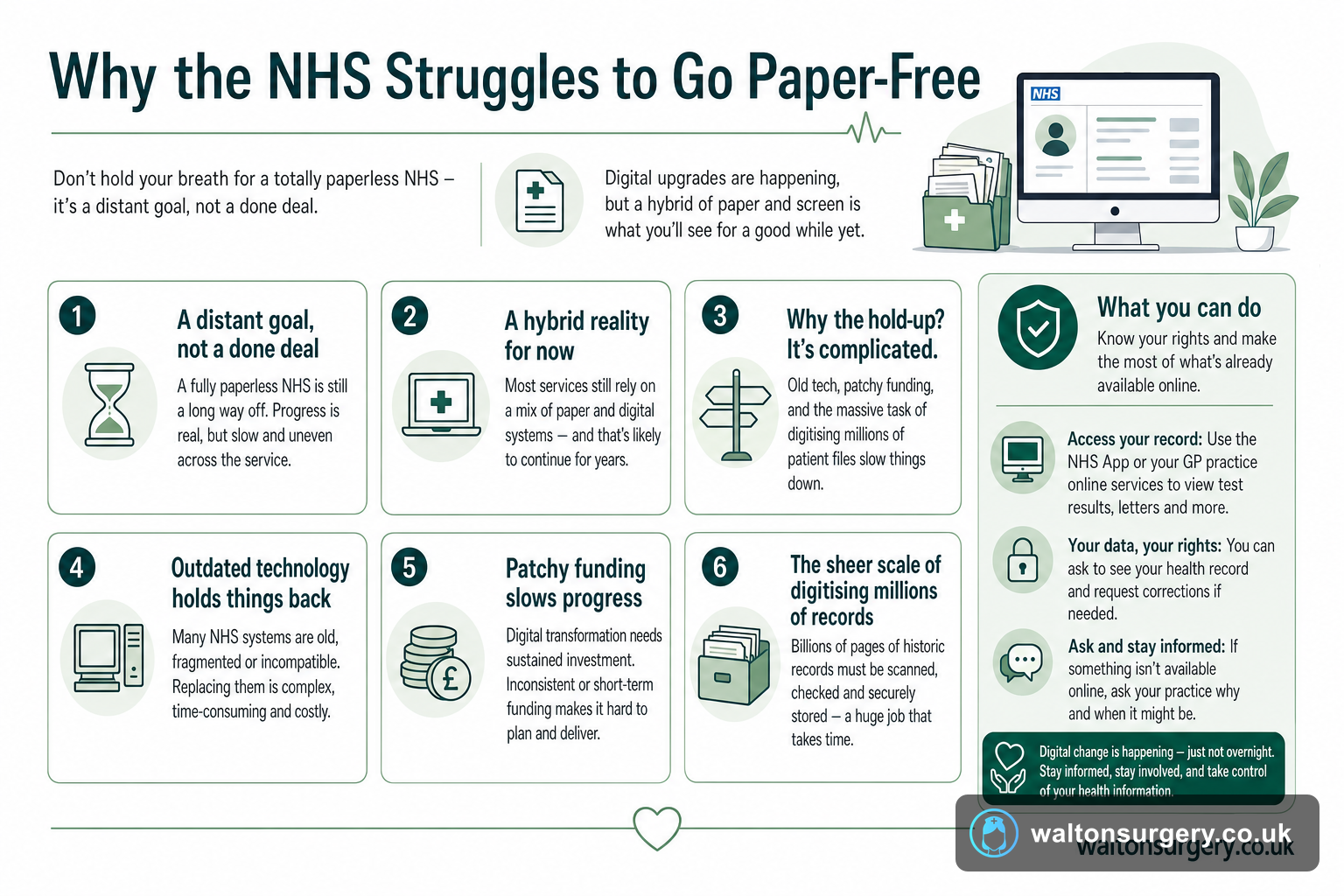
⚡ Quick Answer
Don't hold your breath for a totally paperless NHS — it's a distant goal, not a done deal. Digital upgrades are happening, but a hybrid of paper and screen is what you'll see for a good while yet. Why the hold-up? Old tech, patchy funding, and the sheer hassle of digitising millions of patient files. Your best move is to know your rights and get familiar with what you can already see online.
You might have heard the NHS is going all-digital. That's technically the plan, but a recent look by Medscape makes it clear we're nowhere near that finish line. It's not for want of trying — the obstacles are huge, both money-wise and logistically. What does that mean if you're popping to the doctor? Expect the old mix of paper printouts, letters in the post, and bits that show up on a screen. For the near future, that's just how it's going to be.
What Does "Paper-Free NHS" Actually Mean?
The idea is that all your health info — from what your GP writes down to that discharge summary from a hospital stay — gets created, kept, and shared digitally, and securely, across every part of the NHS. In a perfect world, any clinician looking after you could pull up your whole history in a flash, which would be better for joined-up care and catching mistakes. That vision is meant to swap out the current mess of paper charts, printed letters, and yes, fax machines, which some places still use.
Why Has It Taken So Long?
Calling the NHS large doesn't quite cover it. It's one of the biggest, most tangled public bodies on the planet. Its computer systems aren't one thing; they're a patchwork of thousands of different software bits, many of them ancient ("legacy systems" in the jargon) that simply won't talk to each other. You can't just flick a digital switch. Migrating billions of sensitive records, getting hundreds of thousands of staff up to speed, and making sure every new system ticks the strict data security boxes — that's a generational project, not a quick fix.
The Funding and Resource Reality
Giving a whole national health service a digital overhaul needs a lot of money, and it needs to be sustained. The UK government has put forward billions for NHS tech, but the bills just keep coming. The budget has to stretch for new software, hardware, proper cybersecurity, and — most pressingly — the staff hours for training and moving all that data over. When that money also has to cover frontline nurses, new buildings, and cutting waiting lists, the tech work can stall. That's where those delays everyone notices come from.
🔬 Key Facts
The Scale of the Challenge
- → Thousands of incompatible software systems make a single digital switch impossible.
- → Billions of sensitive patient records need to be migrated securely.
- → Sustained funding must compete with frontline care, buildings, and waiting lists.
- → Staff training and data migration represent a generational project, not a quick fix.
What This Means for Your GP Experience Today
You'll probably still get a paper prescription sometimes, even though electronic ones are now the default. Your GP might print off a summary for you to take to a specialist. Hospital letters often arrive in the post, not by email. Here's the sticking point: move between different NHS trusts — say from your local practice to a hospital across town — and your full digital record might not travel with you smoothly. That gap is why you sometimes get asked the same questions twice or information slips through the cracks.
How to Take Control of Your Own Health Information
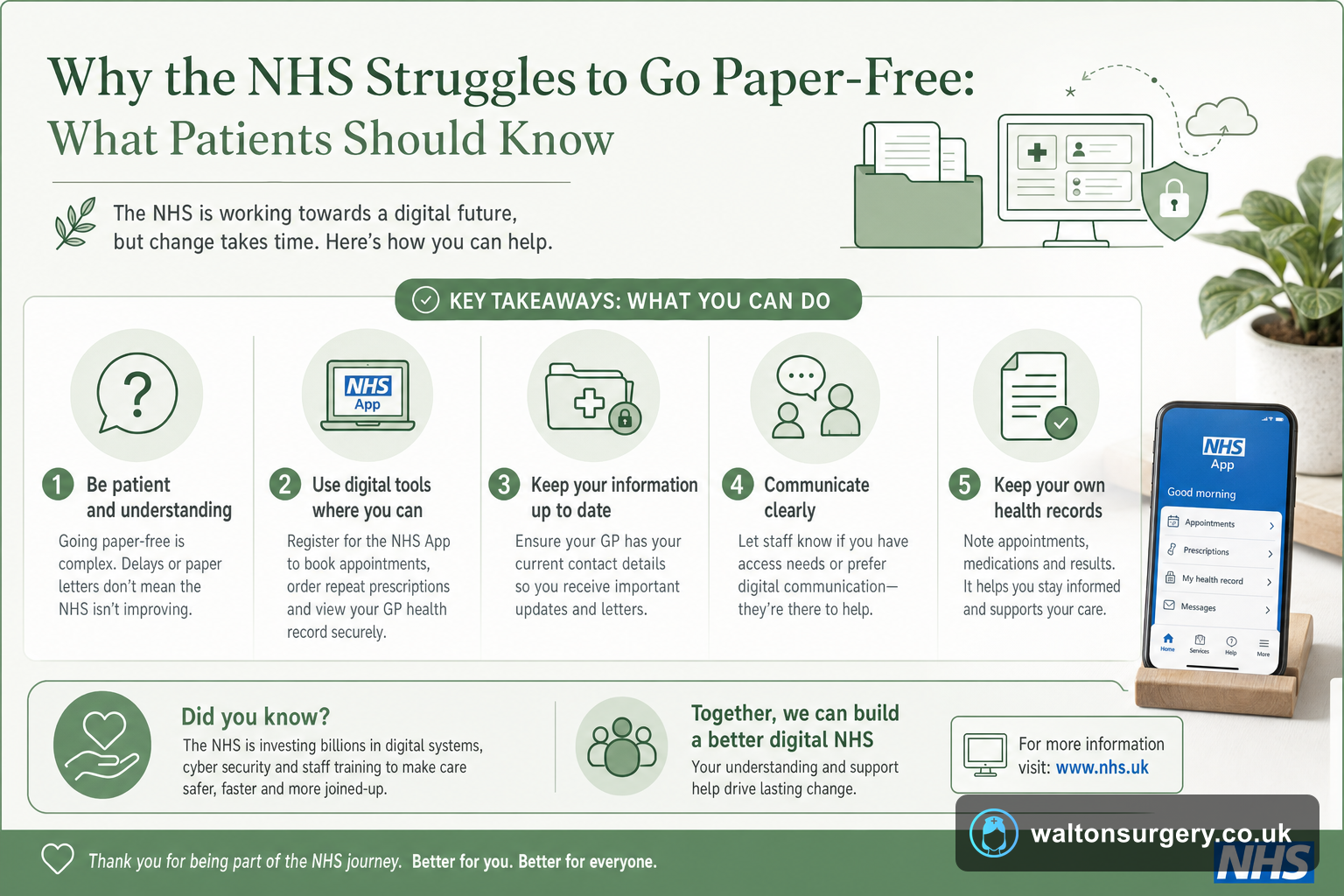
You don't need to sit around waiting for the system to get its act together. You can do things now. You've a legal right to look at your GP records, and you can ask for access via your surgery's online portal or through a formal Subject Access Request. Keeping a simple list of your meds, allergies, and big diagnoses on your phone is a decent backup, just as ensuring you eat enough fruit and vegetable for immune system health is a sensible personal step. And when you're referred somewhere, ask the question: will my info be sent electronically or by letter? That way, you can help fill in any blanks yourself.
The Security and Privacy Balancing Act
Putting records online throws up serious questions about keeping them safe. The NHS has to weigh up the benefit of easy sharing against the absolute necessity of protecting your private data from hackers and leaks. That means complex encryption, tight access controls, and constant watching. Some reckon all that security stuff bogs projects down. Others argue that a well-protected digital system is actually safer than paper files, which can be lost, nicked, or just misread. It's a tricky balance, and there's no simple answer. Patients concerned about how their data reflects their own immune status might even consider an Immune System Blood Test to get a clearer picture of their health, independent of the record-keeping debate. Resources like How to detox your lymphatic system naturally — doctor guide can also offer practical steps for those wanting to take charge of their wellbeing while the NHS system evolves.
Frequently Asked Questions
⭐ The Bottom Line
What this means for you
Getting to a truly paper-free NHS is going to be a long, complicated slog. As a patient, the smartest thing you can do is start using the digital tools already there — the NHS App, your GP's online portal — and keep your own basic health notes to hand. While the system plays catch-up, being someone who asks questions and stays on top of their own info is the best way to make sure you get good care, no matter what format the records are in.
Last updated: 2026-08-08 · Written by the Walton Surgery editorial team · Medical information is for educational purposes only and does not replace advice from a qualified healthcare professional.