Jet Lag: How to Adjust Your Body Clock After Flying
PART C — HTML Body Components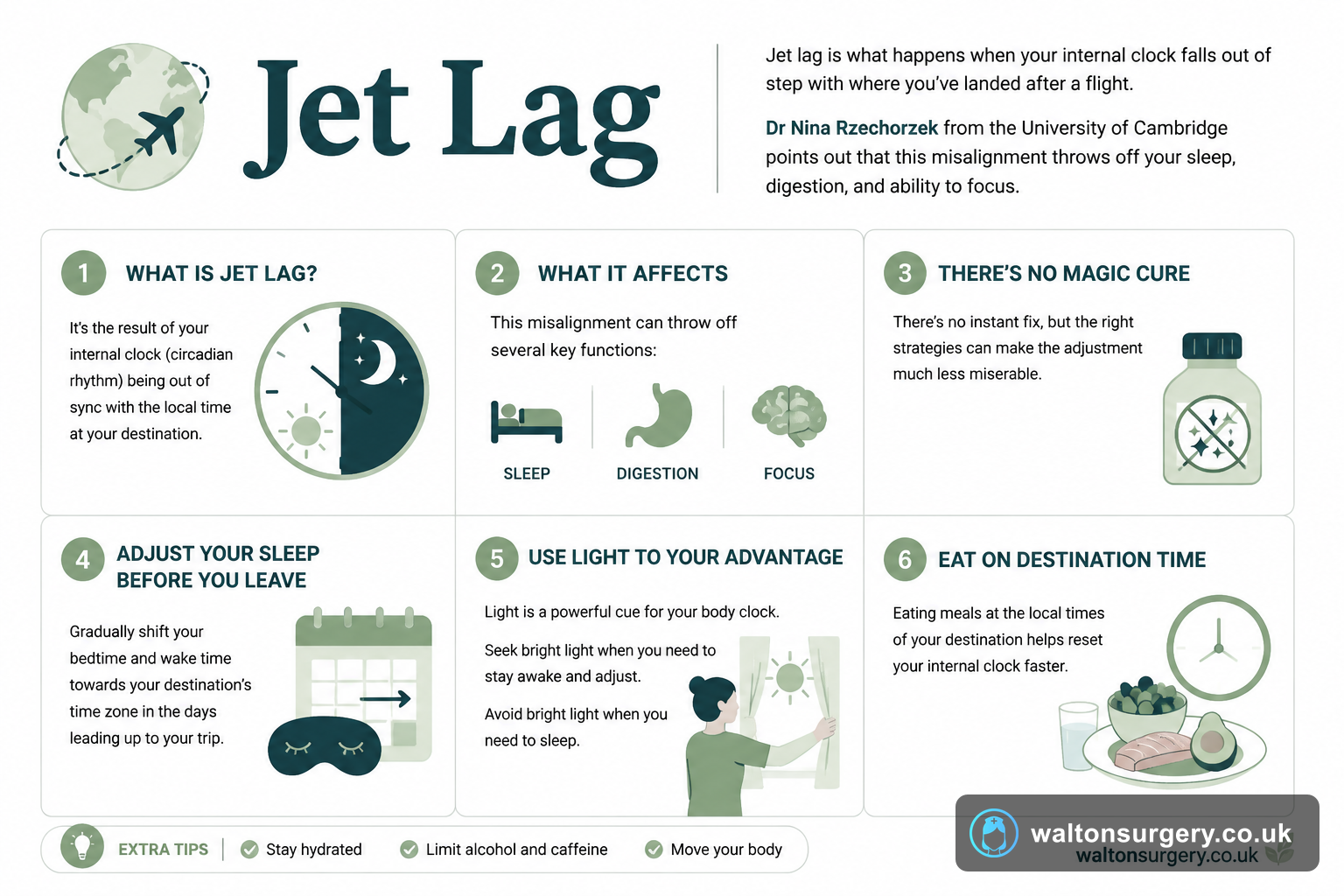
⚡ Quick Answer
Jet lag is what happens when your internal clock falls out of step with where you've landed after a flight. Dr Nina Rzechorzek from the University of Cambridge points out that this misalignment throws off your sleep, digestion, and ability to focus. You can ease the symptoms somewhat by nudging your sleep times before you leave, getting strategic about light exposure to nudge those circadian rhythms back into place, and eating on a schedule that matches your destination. There's no magic cure, but these steps do make the adjustment less miserable.
That disoriented, fuzzy-headed feeling after stepping off a long-haul flight — where local time says one thing but your body stubbornly insists on another — is jet lag. You've crossed several time zones in a matter of hours, but the biological machinery inside you hasn't kept pace. It's still ticking away on home time.
And the consequences aren't limited to feeling a bit sleepy. According to Dr Nina Rzechorzek, who heads up research on brain temperature, sleep, and circadian rhythms at the University of Cambridge, this mismatch can manifest as broken nights, groggy mornings, foggy thinking, short temper, sluggish performance, and your stomach feeling generally unhappy. Once you understand the mechanics behind it, you're in a much better position to do something about it.
What Exactly Is Jet Lag?
It's not the same as just being tired from sitting on a plane for ten hours. What's actually going on is a physiological reaction — your body can't keep up when you hop across several time zones that quickly. Circadian rhythms, which is the fancy term for your body's internal timekeeping, are at the heart of it. Dr Anna Edmondson explains that practically every cell in you runs on its own 24-hour cycle, all coordinated by a master clock sitting in the brain.
Touch down somewhere new and all those cellular clocks are still running on yesterday's schedule. Your brain might be screaming for sleep while everyone around you is having lunch. Or you feel wide awake at 2am local time, staring at the hotel ceiling. That internal tug-of-war produces the telltale symptoms: daytime fatigue that won't budge, lying awake when you should be sleeping, difficulty focusing on anything, and your digestive system throwing a bit of a fit.
How Does Your Body Clock Actually Work?
The master clock lives in a small cluster of neurons called the suprachiasmatic nucleus. Light signals coming through your eyes are what keeps it in step with the world outside. Dr Rzechorzek's work at Cambridge looks closely at the interplay between brain temperature, sleep, and these circadian patterns — how they feed into each other and affect you.
This internal timekeeper doesn't exactly jump to attention when you land somewhere new. Generally it shifts about an hour per day heading east, and maybe a touch quicker going west. So if you've crossed six time zones, you could be feeling rough for the better part of a week. The further you travel, the more your body protests — and eastward trips tend to be tougher on most people than westward ones.
Can You Prepare Before You Fly?
You can actually start easing the transition before you even leave the house. The trick is to gently shift when you go to sleep in the days leading up to your trip. Heading east? Try turning in 30 minutes earlier each night. Going west, nudge your bedtime later by the same amount.
This won't banish jet lag altogether — nothing will, honestly — but it does shrink the distance your body clock needs to cover once you touch down. Even shifting by two or three hours over several days makes a real difference to how you feel stepping off the plane. It's not perfect, but it's something.
How Should You Use Light Exposure?
Nothing resets your circadian system quite like light. It's the single strongest cue your brain listens to. Once you're at your destination, getting outdoors in natural daylight is one of the best things you can do — it tells your brain where you actually are, time-wise.
Flown east and need your clock running earlier? Get bright light in the morning and steer clear of it later in the afternoon. Westward trips work the other way round — soak up light in the late afternoon and early evening hours. While you're actually on the plane, try to sleep or stay awake according to the time it'll be when you land. Sunglasses and pulling down the window shade help when you need shut-eye; being by a window when you want to stay alert does the opposite. Simple enough, though it takes some discipline.
Does What You Eat Matter?
Mealtimes are another signal your body relies on to figure out what time it is. A BBC News report on beating jet lag highlighted that adjusting when you eat can actually support your body clock's transition — it's an underappreciated factor.
Eat at local times from the moment you arrive, even if food is the last thing you want. Heavy meals and alcohol before bed will only make a bad night's sleep worse, and you're already fighting that battle. Keep sipping water throughout the flight too. Dehydration ramps up fatigue and makes all the other symptoms feel considerably more unpleasant than they need to be.
Are There Any Medications That Help?
Melatonin is a hormone your body makes naturally to tell itself it's time to sleep. Some people use it to help reset their clock after crossing time zones. Here in the UK, it's prescription-only and usually intended for short-term use in adults over 55. Worth having a conversation with your GP if you're thinking about it, particularly if you travel for work frequently.
Sleeping pills might knock you out on the plane or at the hotel, but they don't actually shift your circadian rhythms. They can leave you groggy the next day too, and aren't really suited to regular use. Always check with a pharmacist or your doctor first, especially if you've got other health conditions or you're already taking something else.
🔬 Key Facts
Understanding Your Body Clock
- → The master clock lives in a small cluster of neurons called the suprachiasmatic nucleus.
- → Light signals coming through your eyes are what keeps it in step with the world outside.
- → It generally shifts about an hour per day heading east, and maybe a touch quicker going west.
- → Eastward trips tend to be tougher on most people than westward ones.
Frequently Asked Questions
⭐ The Bottom Line
What this means for you
Jet lag isn't just travel tiredness dressed up with a name. It's a genuine physiological response, and your internal clock needs real time to line up with where you've landed. You can't rush that process completely, but morning light, eating on local time, and nudging your sleep schedule beforehand are practical moves that actually make a difference. If you're a frequent traveller or the symptoms hit you particularly hard, it's worth asking your GP whether melatonin or other approaches might be right for your circumstances.
Last updated: 2026-08-12 · Written by the Walton Surgery editorial team · Medical information is for educational purposes only and does not replace advice from a qualified healthcare professional.