Understanding Hysterectomy: When Is It Needed After a Cancer Scare?
PART C — HTML Body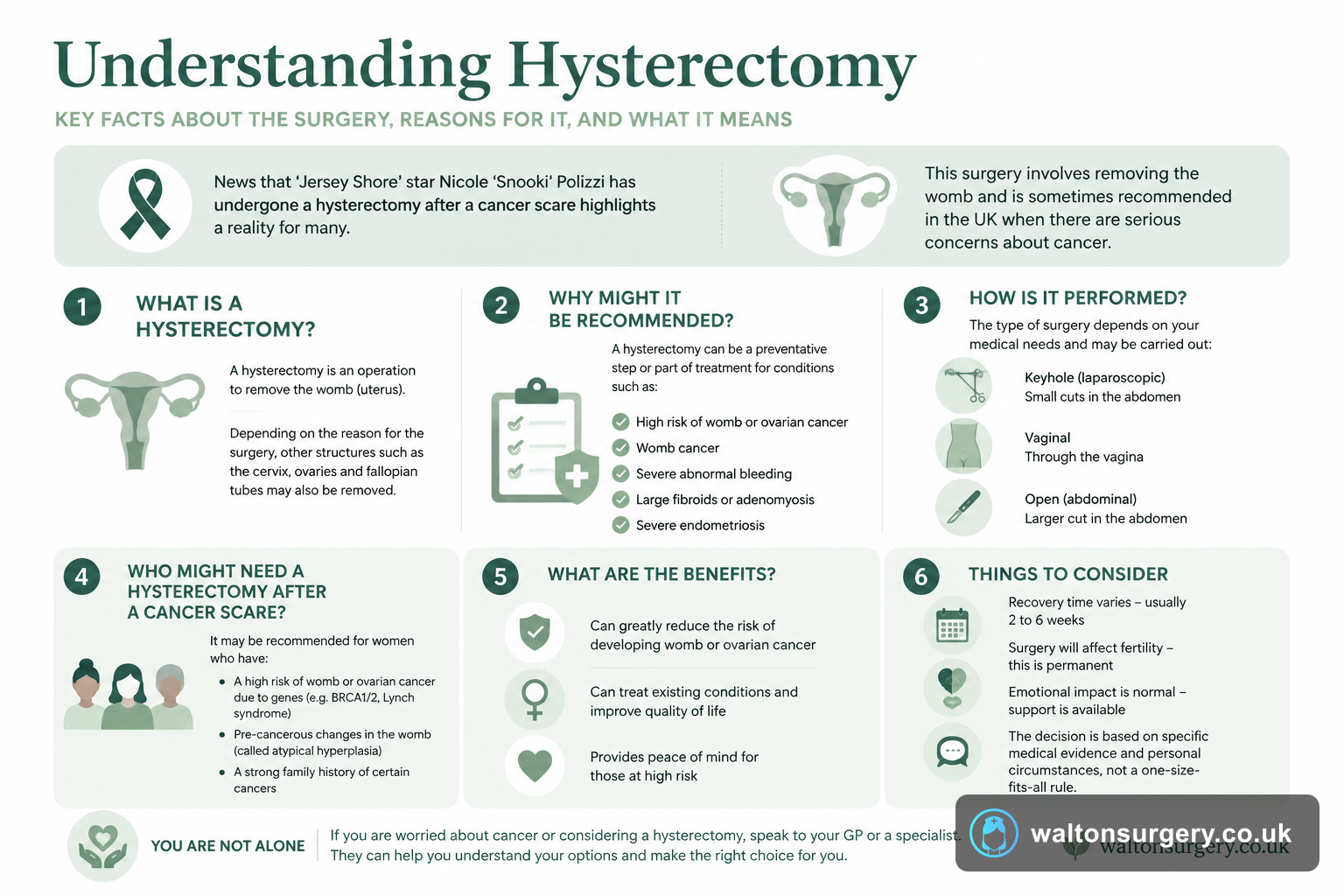
⚡ Quick Answer
News that 'Jersey Shore' star Nicole ‘Snooki’ Polizzi has undergone a hysterectomy after a cancer scare highlights a reality for many. This surgery involves removing the womb and is sometimes recommended in the UK when there are serious concerns about cancer. It can be a preventative step or part of treatment for existing conditions. The decision is based on specific medical evidence and personal circumstances, not a one-size-fits-all rule.
You might have seen the headlines about Nicole ‘Snooki’ Polizzi having a hysterectomy after a cancer scare. When a public figure talks about something so personal, it can make you think about your own health or that of someone close to you. A cancer scare is a deeply unsettling thing to go through, much like the emotional journey following a gordon ramsay skin cancer diagnosis. It can leave you feeling anxious and faced with treatment choices that feel overwhelming.
If you're in that position, or just trying to understand, you're probably wondering what a hysterectomy actually entails and when doctors might bring it up. The National Health Service has fairly clear guidelines on this, but it's rarely the first thing they suggest. It usually comes after other avenues have been looked at. Here's a straightforward look at the facts.
What is a hysterectomy?
It's a major operation to remove the womb, or uterus. In the UK, it's one of the most frequently performed major surgeries on women and people assigned female at birth. Exactly what gets taken out varies. A total hysterectomy means the womb and the cervix are removed. With a subtotal, just the womb goes, and the cervix stays put. Then there's a radical hysterectomy—that one's less common and is usually for cancer treatment. It involves removing the womb, cervix, the top part of the vagina, and some surrounding tissue.
How they do the surgery depends on why you need it and your own medical history. An open surgery means a cut in the abdomen. Keyhole, or laparoscopic, surgery uses smaller incisions. It can sometimes be done through the vagina itself.
Why might a hysterectomy be considered after a cancer scare?
A cancer scare isn't a single diagnosis. It could mean many things—from a worrying test result to a very high inherited risk. The NHS says a hysterectomy might be put forward as a preventative move, what they call prophylactic surgery, for people facing a very high chance of developing certain cancers. Think of those with specific genetic mutations. It can also be a part of the treatment plan if cancer or a pre-cancerous condition has actually been found.
For cervical cancer caught early, a hysterectomy is often on the table. With womb cancer, it's frequently a standard part of dealing with the disease. This kind of decision is never made in a rush. It's the result of lots of discussion between you and a team of specialists—gynaecologists, oncologists—who look at the best evidence. They follow guidelines from organisations like the National Institute for Health and Care Excellence (NICE).
The most common conditions leading to this decision
There are particular health situations that can spark a cancer scare and lead to a conversation about hysterectomy. These aren't choices made from panic, but based on clinical evidence.
Sometimes, cervical screening results come back showing high-grade pre-cancerous changes, known as CIN 3. If these are stubborn or there are other worries, a hysterectomy might be mentioned. Though, to be honest, they usually try less invasive options first, like a loop excision. Another condition is endometrial hyperplasia, where the womb lining gets too thick. If the cells look 'atypical', the risk of it turning into womb cancer goes up, and removing the womb might be advised.
Genetics also matters a great deal. People with a strong family history of ovarian or breast cancer might carry the BRCA1 or BRCA2 gene mutation. The NHS notes that for those with these mutations, risk-reducing surgery to remove ovaries and fallopian tubes is commonly suggested. A hysterectomy can sometimes be done at the same time, but that's a more nuanced call depending on your specific risk profile. Research like the UK Familial Ovarian Cancer Screening Study has shaped this guidance.
The role of pre-cancerous conditions
Pre-cancerous conditions are cell changes that could, but don't always, progress to cancer. When doctors find them, the main goal is to stop that progression. A hysterectomy offers a definitive way to remove the problem area entirely. This is most relevant for the womb and cervix. For cervical pre-cancers that haven't responded to other treatments or are widespread, a hysterectomy can be the permanent fix. For womb conditions, taking the organ out simply removes the chance of womb cancer developing down the line.
What happens before the decision is made?
🔬 Key Facts
The Path to Surgery
- → Thorough investigations including scans and biopsy provide the hard evidence.
- → A detailed chat with a specialist discusses all options and their pros and cons.
- → A shared decision is made, where you fully grasp the medical reasoning.
- → You can always ask for a second opinion.
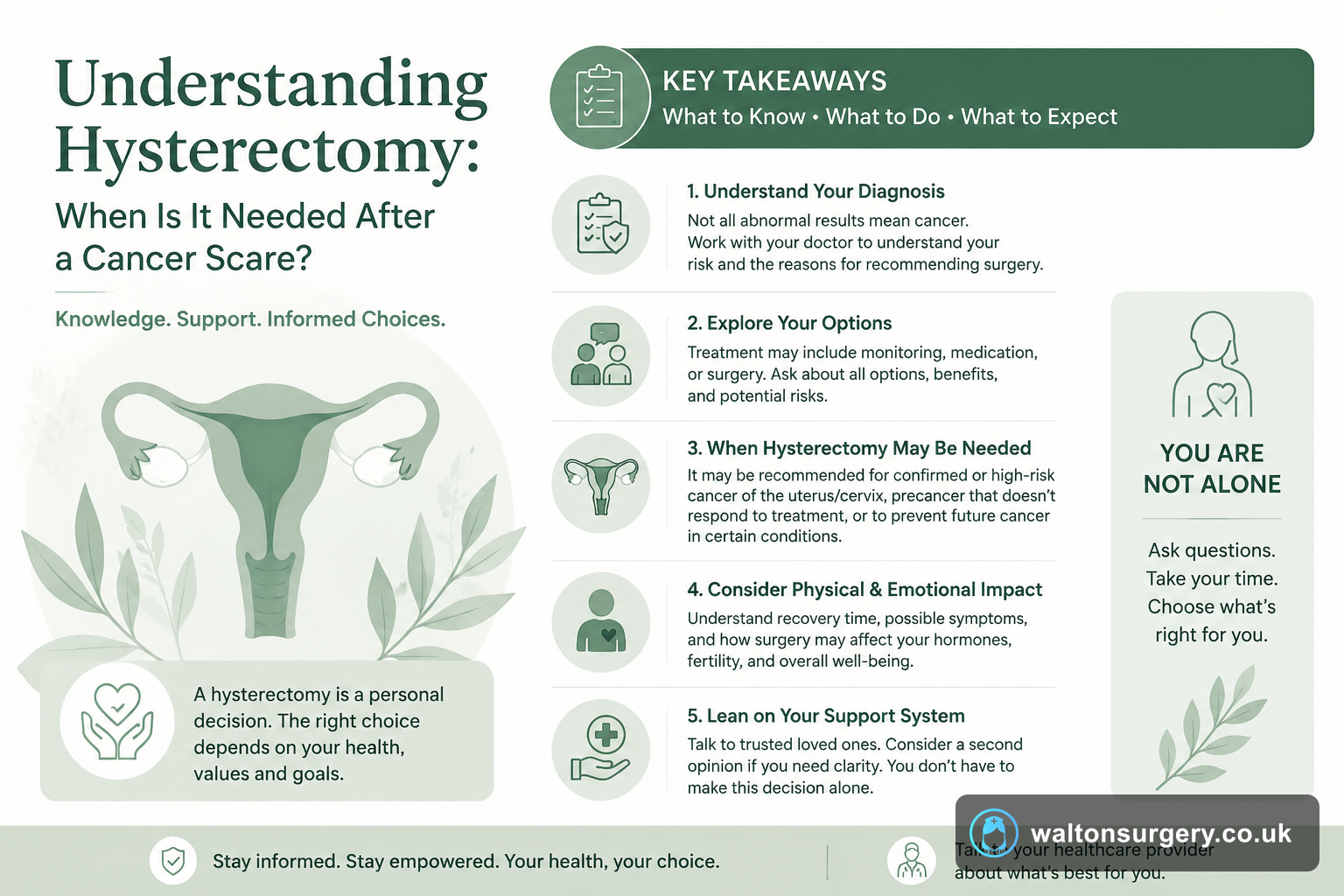
Getting to a hysterectomy after a cancer scare follows a path, and it's all guided by NHS protocols. First, you'd have thorough investigations. This typically means more detailed scans, like an ultrasound or MRI, and very often a biopsy. A small piece of tissue is taken so a pathologist can examine it closely under a microscope. This gives the hard evidence needed for any informed choice.
After that comes a detailed chat. A consultant gynaecologist or a gynaecological oncologist will go through the results with you. They'll talk about all the possible treatments—which might include watching and waiting, medication, or other surgeries—and lay out the pros and cons of a hysterectomy for your particular case. They'll explain what type they'd recommend and the reasons why. You get to ask questions and talk about how you feel, what matters to you. You can always ask for a second opinion too. The aim is a shared decision, where you fully grasp the medical reasoning and what it means for your health going forward, including recovery and longer-term effects like menopause if your ovaries are also taken out.
Living after a hysterectomy: what to expect
Recovering from a hysterectomy is a significant physical undertaking. You'll usually be in hospital for a few days, maybe longer if it was open surgery compared to keyhole. The NHS says full recovery can take six to eight weeks for a laparoscopic hysterectomy, and up to twelve weeks for an abdominal one. No heavy lifting or intense exercise during that time.
One of the biggest long-term things to think about is the menopause. If your ovaries are removed during the operation—an oophorectomy—you'll go through immediate surgical menopause. Symptoms like hot flushes, mood swings, and vaginal dryness can start pretty soon after. Hormone Replacement Therapy (HRT) is often recommended to help manage these, and you'd talk about that with your doctor before the surgery happens. Even if your ovaries are left alone, you might hit the menopause a year or two earlier than you would have naturally. The emotional side is real and valid too. Many people feel a sense of grief or loss, even when the surgery was medically necessary. Support from your healthcare team, counsellors, or groups like The Daisy Network, which helps with premature ovarian insufficiency, can make a real difference. You might also consider looking into support for malnutrition after cancer diagnosis as part of your holistic recovery.
The journey doesn't end with surgery; it's a new chapter. Just as celebrities like Jessie J share their stories of recovery, such as her jessie j cancer free breast cancer mastectomy update 2026, your path is your own, and finding the right support is key.
Frequently Asked Questions
⭐ The Bottom Line
What this means for you
Nicole ‘Snooki’ Polizzi’s experience brings the serious reality of cancer scares and hysterectomy into public view. In the UK, the decision for a hysterectomy after a cancer scare is a medically guided one, based on specific evidence from biopsies and scans, and guidelines from the NHS and NICE. It is considered for high genetic risk or to treat pre-cancerous and early-stage cancerous conditions. The process involves detailed consultation to weigh benefits against the significant physical and emotional impacts of the surgery. This is not personalised medical advice; always discuss your personal situation with your GP or specialist.
Last updated: 2026-08-01 · Written by the Walton Surgery editorial team · Medical information is for educational purposes only and does not replace advice from a qualified healthcare professional.