Understanding a Cancer Diagnosis: Support and Next Steps in the UK
⚡ Quick Answer
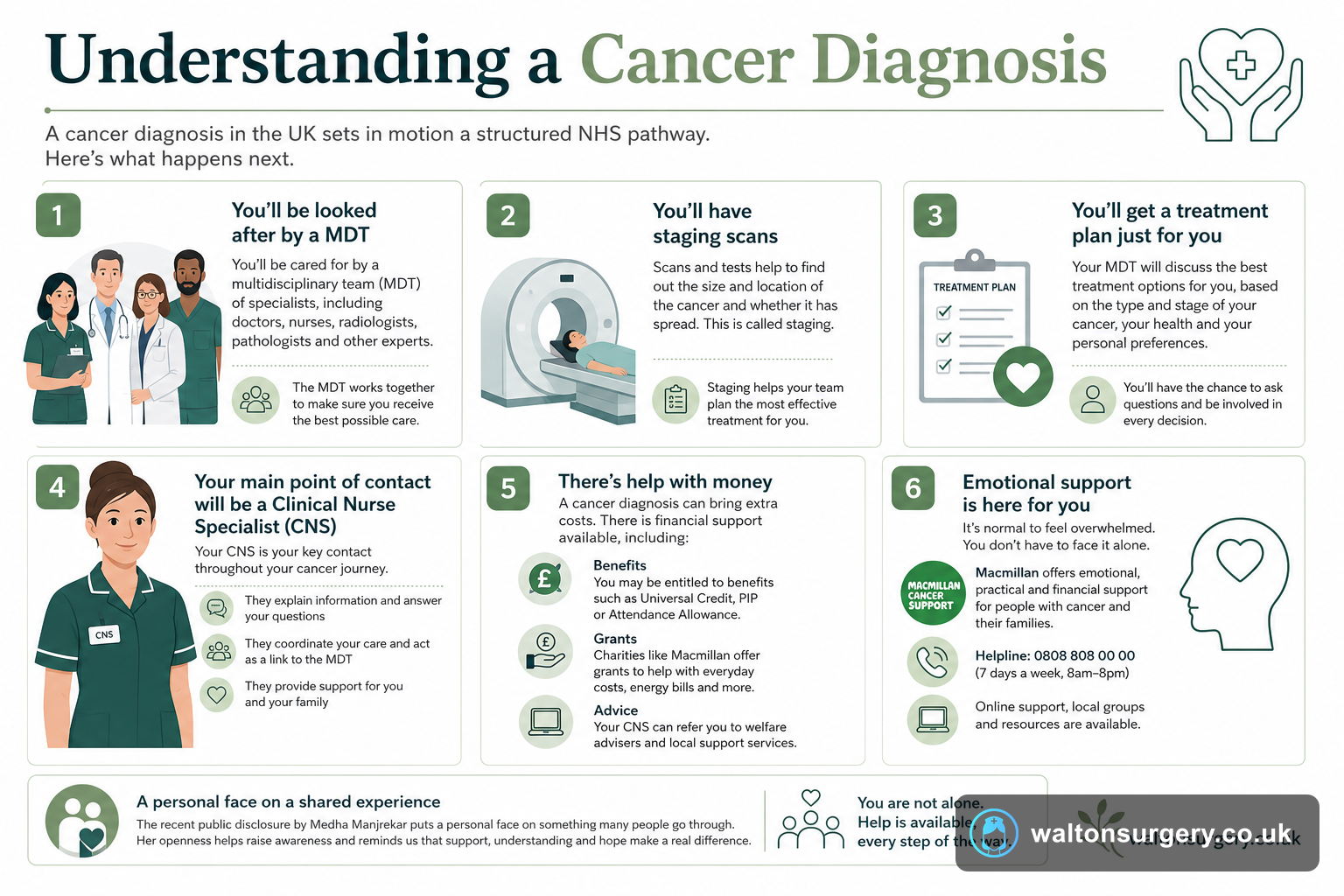
A cancer diagnosis in the UK sets in motion a structured NHS pathway. You'll be looked after by a multidisciplinary team (MDT), go through staging scans, and get a treatment plan that's put together just for you. Your main point of contact will be a clinical nurse specialist, or CNS. There's help with money through benefits and grants, and emotional support from charities like Macmillan. The recent public disclosure by Medha Manjrekar puts a personal face on something many people go through.
A cancer diagnosis turns your world upside down. That's not a cliché; it's just what happens. The shock, the fear, and then all the questions flood in about what you're supposed to do next. In the UK, the National Health Service (NHS) has a pathway for this, a structured route designed to walk you through everything from figuring out what kind of cancer you have to planning treatment and finding the right support. The shock of such a diagnosis often prompts people to search for examples, whether it's a public figure's health battle or a trump family member cancer diagnosis, but for you, the immediate concern is the medical process ahead.
What this article does is lay out that NHS process for you. We'll go over who the medical people are that you'll actually meet, what the tests are that determine your treatment, and the practical and emotional support that's out there for you and your family. Just remember, this is general guidance. Your own medical team will be the ones giving advice that's actually tailored to your specific situation.
Your First Steps After a Diagnosis
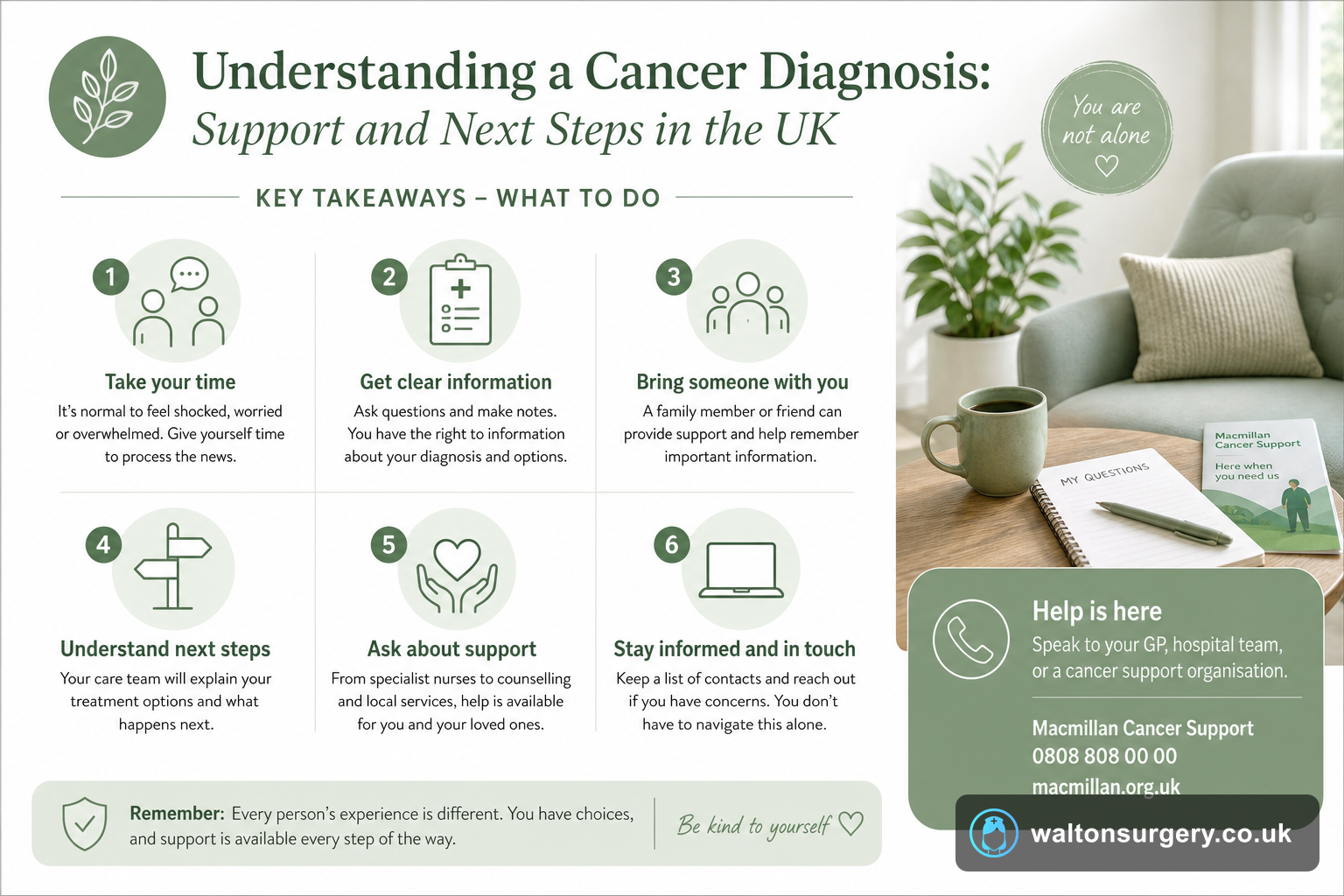
The time right after you hear the word 'cancer' is often a bit of a blur. The news might have come from your GP, a hospital consultant, or a specialist nurse. The most important thing to do first is get a clear picture of what you're dealing with. Ask for the exact name and type of cancer, where it is, and if they know, the stage. Don't worry if you can't take it all in at once. You will get more chances to ask questions.
Your next appointment will probably be with a consultant or a senior nurse at the hospital. This is where your care gets properly managed. You should be offered a Clinical Nurse Specialist, or CNS. This nurse becomes your dedicated person, your guide through the system, someone to give you information and support. Make sure you get their name and how to reach them.
The Role of Your Multidisciplinary Team (MDT)
No single doctor makes your treatment decisions alone. In the NHS, your case gets talked about by a Multidisciplinary Team, or MDT. It's a group of healthcare professionals who meet regularly to plan the best care for each patient. The MDT usually includes a surgeon, if surgery is being considered, and a medical oncologist, that's a doctor who specialises in treating cancer with drugs like chemotherapy. There's also a clinical oncologist, who deals with radiotherapy and drug treatment. A radiologist will be there to interpret your scans, and a pathologist to look at tissue samples. Your Clinical Nurse Specialist is part of it too, along with any other specialists that might be relevant, say a dietitian or physiotherapist.
The MDT looks over all your test results and scans to agree on a treatment plan they can recommend. That plan then gets discussed with you, usually by your consultant or CNS. You are part of this decision-making process, remember that.
Understanding Staging and Scans: What the Results Mean
To plan the right treatment, your team needs to know how far the cancer has gone. This is called staging. It's about finding out the size of the tumour and whether it's spread from where it first started. The results guide everything that comes after.
You'll probably have a combination of tests. These might include CT scans, which use X-rays to make detailed cross-sectional images, or MRI scans, which use strong magnetic fields and radio waves for detailed pictures of organs and tissues. PET-CT scans can show how active cells are and are often used to check if cancer has spread. You might also have ultrasound scans and blood tests.
The results of these scans will put your cancer into a stage, usually from 1 to 4. Stage 1 means the cancer is small and still contained, while Stage 4 means it has spread to other parts of the body. Your doctor will explain what your specific stage means for you, because the numbers on their own don't tell the whole story.
Decoding Your Treatment Plan: Surgery, Chemotherapy, and Radiotherapy
Once staging is done, your MDT will recommend a treatment plan. It could be one treatment or a combination of a few. The main types are surgery, which is an operation to remove the cancer and is often the primary treatment for solid tumours that haven't spread. Then there's chemotherapy, the use of anti-cancer drugs to kill cancer cells or stop them from growing. It can be given before surgery to shrink a tumour, after surgery to kill any remaining cells, or as the main treatment. And radiotherapy, which uses high-energy rays, similar to X-rays, to destroy cancer cells. It's often targeted at a specific area of the body.
Your plan might also include newer treatments like immunotherapy or targeted therapy, which work in different ways to attack cancer cells. Your consultant will explain what each recommended treatment is for, how you'll get it, what the possible side effects are, and how they'll measure success. You have the right to ask for time to think about your options and to get a second opinion if you want one, a right affirmed for patients regardless of whether the diagnosis involves a celebrity like the recent beverley callard cancer diagnosis or your own private medical journey.
Who Will Be in Your Corner? Key Support Roles
You'll meet a whole team of professionals during this. Knowing who does what can help you feel a bit more in control.
Your GP stays your primary doctor for general health issues. They'll get letters about your diagnosis and treatment and can help manage side effects or other health concerns. The Clinical Nurse Specialist, your CNS, is your key worker. They coordinate your care, give you information, offer emotional support, and are your first point of contact for questions or worries between appointments.
A surgeon, if surgery is part of your plan, and their team will manage that side of things. An oncologist is a doctor who specialises in cancer treatment and oversees your chemotherapy, radiotherapy, or drug therapy. A radiographer is a healthcare professional who plans and delivers radiotherapy treatments. A dietitian can offer advice on nutrition, which can be a real challenge during treatment. And a physiotherapist or occupational therapist helps with movement, strength, and managing daily activities if treatment affects your physical abilities.
Don't be shy about asking your CNS to connect you with any of these specialists.
🔬 Key Facts
Your NHS Support Team
- → MDT Decision Making: Decisions aren't made by one doctor; they are made by a Multidisciplinary Team including surgeons, oncologists, radiologists, and pathologists.
- → Clinical Nurse Specialist (CNS): This nurse is your dedicated guide and key worker to coordinate care and support.
- → Staging Accuracy: Scans (CT, MRI, PET-CT) are used to determine the cancer stage (1-4), which guides the entire treatment plan.
- → Ancillary Support: Access to Dietitians, Physiotherapists, and Occupational Therapists is part of standard care.
Financial and Practical Support Available to You
A cancer diagnosis often brings money worries. You might need to cut your working hours or stop working altogether. The UK has systems in place to help with this.
You may be entitled to benefits like Universal Credit, Employment and Support Allowance (ESA), or Personal Independence Payment (PIP). Macmillan Cancer Support has detailed information on all this and can actually help you with applications. Some charities offer one-off grants to help with costs like travelling to hospital or heating bills. The NHS Healthcare Travel Costs Scheme, or HTCS, can help with the cost of getting to and from hospital for treatment if you're on a low income.
If you're receiving treatment for cancer, you're entitled to apply for a medical exemption certificate. This gives you free NHS prescriptions. Your local council or charities like Marie Curie may be able to provide support with personal care, meals on wheels, or sitting services to give your carer a break.
It's a good idea to speak to a welfare rights adviser or a Macmillan benefits adviser as soon as you can. They can help you understand what you're actually entitled to.
Frequently Asked Questions
⭐ The Bottom Line
What this means for you
A cancer diagnosis launches you onto an NHS pathway with defined steps: staging, MDT discussion, and a personalised treatment plan. Your Clinical Nurse Specialist is your navigator through all of it. Practical support for finances, travel, and home life is available through NHS schemes and charities like Macmillan. The path is daunting, no doubt about it, but you are not alone. Structured medical care and a network of support are in place to help you through, and resources explaining survivorship journeys, such as the recovery story detailing the jessie j cancer free breast cancer mastectomy update 2026, offer hope for the future.
Last updated: 2026-07-14 · Written by the Walton Surgery editorial team · Medical information is for educational purposes only and does not replace advice from a qualified healthcare professional.