Carrie Ann Inaba's Sjögren's Disease: Symptoms, Causes and Treatment
⚡ Quick Answer
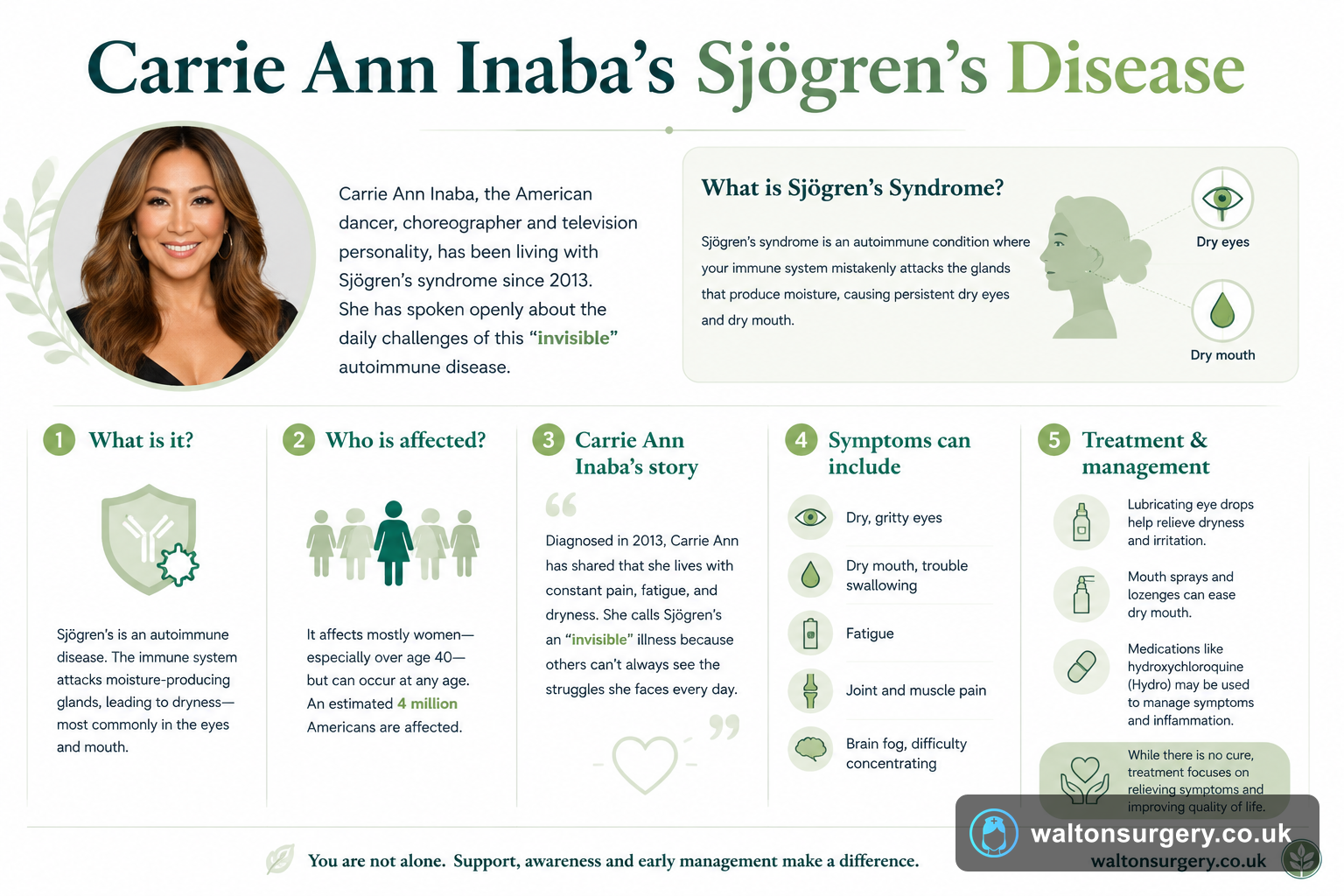
Sjögren's syndrome is an autoimmune condition where your immune system mistakenly attacks the glands that produce moisture, causing persistent dry eyes and dry mouth. The American dancer and television personality Carrie Ann Inaba, a judge on *Dancing with the Stars*, has spoken publicly about her diagnosis since 2013. She describes living with constant pain, fatigue, and dryness, and calls it an "invisible" illness. There is no cure, but treatment focuses on relieving symptoms with lubricating drops, mouth sprays, and sometimes medications like hydroxychloroquine.
It was back in 2013 when Carrie Ann Inaba, known to many as a judge on Dancing with the Stars, finally got a name for what had been bothering her for roughly ten years: Sjögren's syndrome. Before that, the symptoms were just a confusing list nobody could connect. She's put it quite plainly herself: "I look like, maybe I'm feeling fine, but I live with constant pain, constant dryness in my eyes and in my mouth, constant fatigue."
Sjögren's syndrome (you might also see it called Sjögren's disease) is an autoimmune condition. Basically, your immune system decides to attack the glands that are supposed to make fluid for you — mainly the ones producing tears and saliva. It hits women much more often than men, and because the symptoms can look like so many other things, getting a proper diagnosis can drag on for years. Carrie Ann's decade-long wait is a pretty common story. There's more on this in our bryan johnson incurable disease diagnosis explainer.
What Is Sjögren's Syndrome?
This is a long-term autoimmune condition, meaning your body's defence system gets confused and starts attacking your own healthy tissue. Normally, your immune system is there to fight off infections and keep you well. In Sjögren's, the primary targets are the moisture-producing glands, especially the tear glands (lacrimal glands) and the salivary glands in your mouth.
The ongoing attack causes inflammation and ends up damaging those glands, so they can't make tears and saliva like they should. It doesn't stop there, either. The condition can have a knock-on effect on other parts of your body that depend on moisture, like your skin, nose, throat, the airways, your gut, and even the vagina.
Doctors split it into two types:
- Primary Sjögren's syndrome turns up on its own, without another autoimmune condition being in the picture.
- Secondary Sjögren's syndrome shows up alongside another autoimmune disease, things like rheumatoid arthritis or lupus.
Carrie Ann Inaba has talked openly about the struggle to get diagnosed. Her doctors, like many do, failed to connect the dots between her symptoms at first. It was only after an ophthalmologist — that's an eye doctor — sent her to see a rheumatologist that things finally started making sense. A rheumatologist is the specialist you see for conditions affecting the joints, bones, and muscles.
What Are the Main Symptoms of Sjögren's Disease?
The classic signs most people hear about are dry eyes and a dry mouth. But the condition can actually throw a much wider range of symptoms at you, which is a big part of why it's so tricky to pin down.
Carrie Ann Inaba described it like this: "I look like, maybe I'm feeling fine, but I live with constant pain, constant dryness in my eyes and in my mouth, constant fatigue." That really sums up what a lot of people with Sjögren's deal with — a collection of persistent, often hidden symptoms that just make everyday life harder.
The NHS and Arthritis UK list the main symptoms as follows:
Eyes:
- Dry, gritty, or burning eyes
- Sensitivity to light
- Red or swollen eyelids
- Blurred vision
Mouth and throat:
- A dry mouth, which can make swallowing or speaking difficult
- A burning or sore sensation in your mouth
- A dry, cracked tongue
- You're more likely to get dental cavities and oral infections, because saliva normally protects your teeth
Other areas of the body:
- Dry skin, which can get itchy or sore
- Dryness in the nose, throat, and airways, which might cause nosebleeds or a cough that just hangs around
- Vaginal dryness
- Joint pain and stiffness
- Extreme fatigue — the kind of tiredness that even a full night's sleep doesn't fix
The fatigue and joint pain bits are often missed, but honestly, they're a massive part of the condition for a lot of people. Carrie Ann Inaba has also pointed out the mental health side of things, talking about the depression, anxiety, and just plain not knowing when a flare-up is going to strike.
Why Does Sjögren's Syndrome Happen?
Nobody knows the exact cause. What is understood is that it's an autoimmune condition — your immune system, for reasons researchers are still trying to figure out, starts attacking your own moisture-producing glands.
According to NHS inform, a few things might contribute:
- Genetics: You could be born with genes that make you more likely to get autoimmune conditions. Having those genes doesn't mean you'll definitely get Sjögren's, though — it just bumps up your risk.
- Hormones: The condition is way more common in women. About nine out of ten people with Sjögren's are female, and it often starts around the menopause. So hormones are thought to have something to do with it.
- A trigger: It's believed that something in the environment — maybe a viral infection — could set the condition off in someone who's already genetically susceptible.
You can't catch it from anyone. And it's not because of anything you did or didn't do. If you have it, it's simply not your fault.
How Is Sjögren's Syndrome Diagnosed?
Getting a diagnosis can be a slow business. The symptoms — dry eyes, dry mouth, tiredness, achy joints — overlap with loads of other conditions. Menopause, rheumatoid arthritis, fibromyalgia, even just stress can look similar, so it can take years to get the right answer.
Carrie Ann Inaba's experience is a good case in point. She lived with symptoms for roughly a decade before being diagnosed in 2013. It was an ophthalmologist who finally referred her to a rheumatologist, the specialist who actually manages Sjögren's.
If you go to your GP with symptoms that might point to Sjögren's, here's what typically happens:
1. A chat about your symptoms — your GP will want to know about dry eyes, dry mouth, fatigue, joint pain, and how long it's all been going on.
2. A referral to a rheumatologist — if your GP thinks Sjögren's could be the issue, you'll be sent to a specialist. The NHS says diagnosis usually involves a rheumatologist.
3. Blood tests — these look for specific antibodies that are often found in people with Sjögren's. The main ones are anti-SSA (also called anti-Ro) and anti-SSB (anti-La) antibodies, and they'll also check for markers of inflammation.
4. Eye tests — an ophthalmologist or optometrist can run tests to see how dry your eyes actually are. A common one involves putting special dye drops in your eyes to watch how fast your tears evaporate.
5. A lip biopsy — sometimes, a small piece of tissue is taken from inside your lower lip. It's examined under a microscope to see if the salivary glands have been damaged by the autoimmune process.
Not everyone will need every single test. Your rheumatologist will look at your symptoms and initial results to figure out which ones make sense for you.
🔬 Key Facts
Diagnosing Sjögren's Syndrome
- → Blood tests look for anti-SSA (anti-Ro) and anti-SSB (anti-La) antibodies and markers of inflammation.
- → Eye tests use special dye drops to measure how fast your tears evaporate.
- → A lip biopsy examines tissue from inside your lower lip for salivary gland damage.
- → Diagnosis typically involves a referral to a rheumatologist, the specialist who manages Sjögren's.
How Is Sjögren's Syndrome Treated?
There is no cure for Sjögren's syndrome. What doctors can do is manage your symptoms and try to prevent complications. The exact approach depends on which parts of you are affected and how bad things get.
The NHS and Arthritis UK outline the main treatment options:
For dry eyes:
- Lubricating eye drops (artificial tears), which you can buy at a pharmacy without needing a prescription
- Eye gels or ointments, especially useful at night
- If things are more severe, your ophthalmologist might suggest other treatments to help your eyes hold onto moisture better
For dry mouth:
- Mouth gels, sprays, and lozenges that either replace saliva or encourage your body to make more
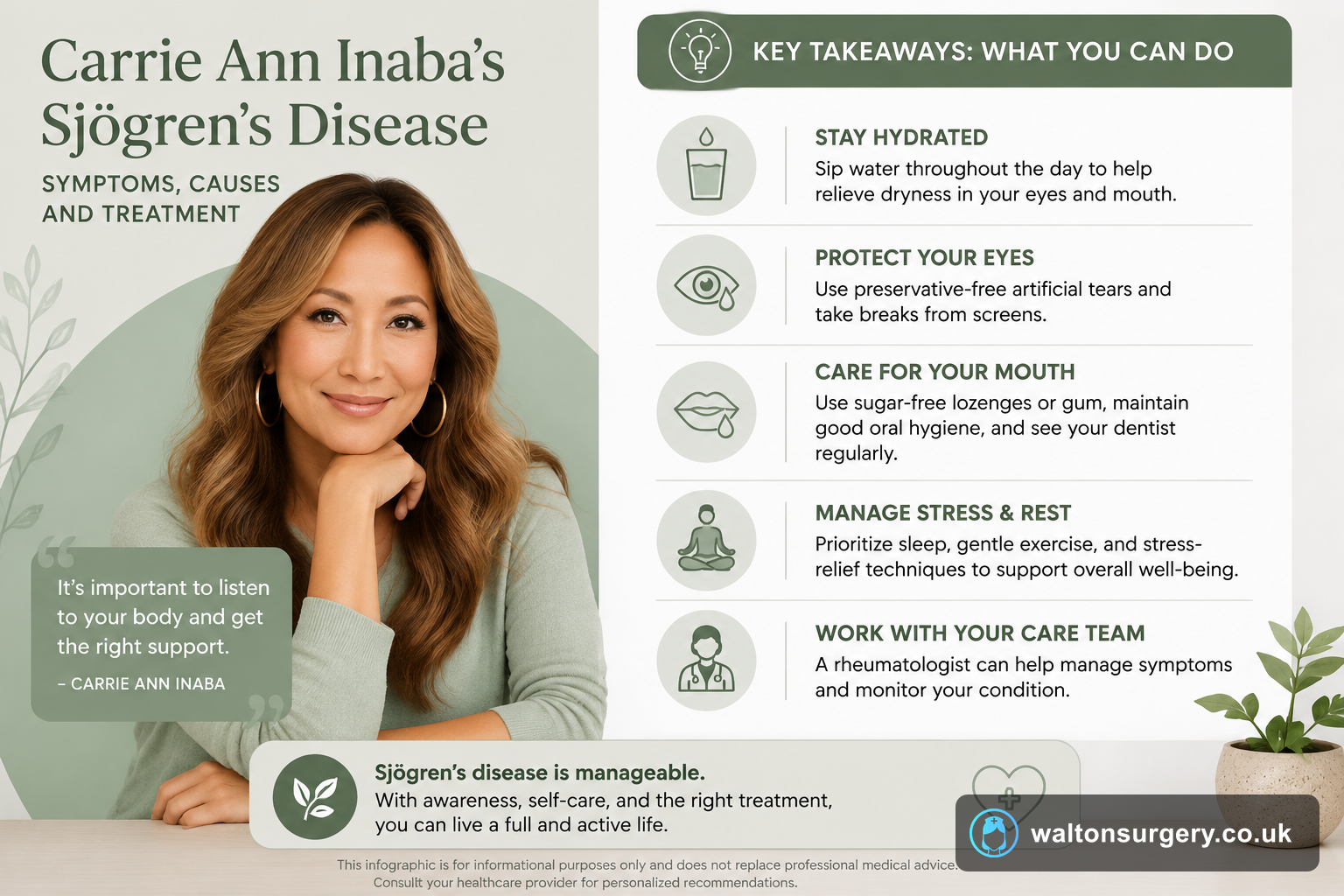
- Sipping water regularly throughout the day
- Sugar-free chewing gum, which can get the saliva flowing
- Looking after your teeth really well, because less saliva means a higher risk of decay. Getting to the dentist for regular check-ups matters a lot here
For dry skin:
- Moisturising creams and emollients, the kind you can pick up at any pharmacy
- Steering clear of harsh soaps and long, hot showers
For joint pain and fatigue:
- Hydroxychloroquine — a disease-modifying anti-rheumatic drug (DMARD) — might be prescribed by your rheumatologist to dial down inflammation. It's a common choice for people with Sjögren's who have joint pain or more widespread (systemic) symptoms
- Gentle, regular exercise can make a real difference to joint stiffness and tiredness
- Learning to pace yourself and building rest breaks into your day
Carrie Ann Inaba has been clear that there's no cure and that she focuses on managing her symptoms. She now helps raise awareness through the Sjöut campaign with Novartis, pushing people — particularly women — to talk about their symptoms and get help.
If your symptoms are getting in the way of daily life, your GP or rheumatologist can help you find the right mix of treatments. What does the trick for one person might not work for another, so it can involve a bit of trial and error.
Living with Sjögren's: Carrie Ann Inaba's Perspective
Carrie Ann Inaba hasn't shied away from talking about what it's like to live with Sjögren's. She calls it an "invisible" illness, one that people often don't understand. From the outside, she might look perfectly fine. On the inside, though, she's dealing with pain, dryness, and exhaustion that just don't let up.
She's spoken about the mental health toll too — the depression and anxiety that come with managing a chronic illness, plus the worry of never knowing when a flare-up might hit. These are things a lot of people with Sjögren's know all too well.
One of her biggest messages is about standing up for yourself. Because the condition can be so hard to pin down, she urges people — especially women — to trust what their body is telling them and to keep pushing for answers if something feels off. Her own doctors missed the connections for years, and she wants to make sure others don't end up waiting as long as she did.
Through her work with Novartis and the Sjöut awareness campaign, she's helping shine a light on a condition that touches many lives but still flies under the radar for most people.
When Should You See a GP?
You should book in with your GP if you're dealing with:
- Dry eyes that just won't settle, even with over-the-counter lubricating drops
- A dry mouth that isn't down to medication you're taking or not drinking enough
- Unexplained tiredness, especially if it comes alongside dry eyes or dry mouth
- Joint pain or stiffness with no obvious reason
It's a good idea to jot down your symptoms, how long you've had them, and how they're affecting your day-to-day life. That sort of information is really useful for your GP and for any specialist you might end up seeing.
A quick reminder: many of these symptoms can be caused by other things. Having one or two of them doesn't automatically mean you've got Sjögren's. But if they're sticking around and dragging down your quality of life, it's definitely worth getting checked out.
This article provides general information and is not a substitute for personalised medical advice from your GP or specialist.
Frequently Asked Questions
⭐ The Bottom Line
What this means for you
Sjögren's syndrome is a long-term autoimmune condition that brings dryness, fatigue, and joint pain. There's no cure for it, but you can manage symptoms with lubricating eye drops, mouth products, moisturisers, and sometimes hydroxychloroquine. Carrie Ann Inaba has been willing to talk openly about what she goes through, and that's helped raise awareness of a condition people still don't know much about. If you've got persistent dry eyes, a dry mouth, or tiredness you can't explain, go and see your GP. Getting referred to a rheumatologist is how you'll get the right diagnosis and a proper treatment plan in place.
Last updated: 2026-07-24 · Written by the Walton Surgery editorial team · Medical information is for educational purposes only and does not replace advice from a qualified healthcare professional.